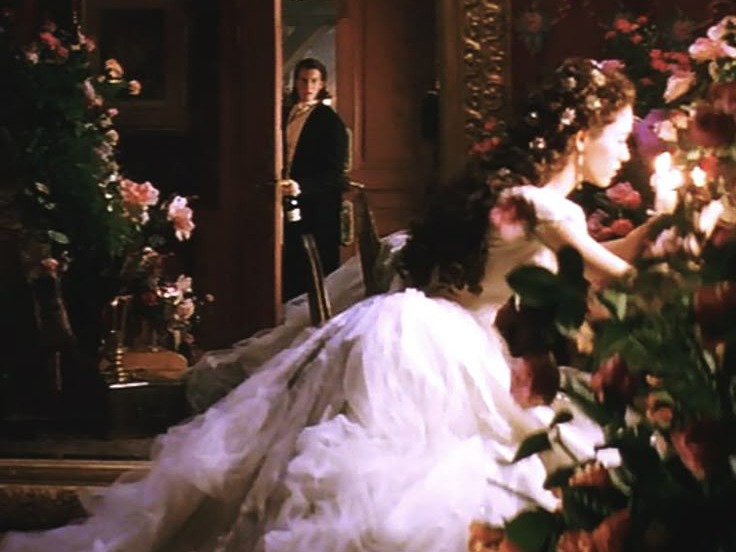
Christine Daaé is the Real Hero of The Phantom of the Opera
Written by Sinta MK
Christine saves herself amidst danger. No guns or strategy involved, just a pure act of compassion that withstands violence. She appears to be the perfect example of the “damsel in distress” archetype — a woman in danger saved by a knight.
Christine's complicated feelings, combined with her inability to mentally escape, fuel the notion that she needs to be rescued. Even Raoul, her childhood love interest, is certain that he is meant to fulfill that role. But how does an act of compassion free her, when the one she faces is a dangerous, ingenious man with eyes everywhere — known as the opera ghost?
”In which the author of this singular work informs the reader how he acquired the certainty that the opera ghost really existed."
The Phantom of the Opera makes the most compelling opening lines for a mystery novel I’ve ever discovered. The author, Gaston Leroux — positioning himself as the historian — convinced readers that all the mischief was real. The opera ghost is one of them.
Christine Daaé is among the people who dismiss its existence. While her friends make a fuss about the phantom’s tricks, she occupies herself with honing her craft: singing. Her skepticism about the phenomenon shows that she isn't superstitious. Yet, Christine receives her training from another “ethereal” figure, whom she calls the Angel of Music.
Before passing away, her father had promised to send her the majestic being. It is said to bestow greatness upon one's musicality. One day, a beautiful, shapeless voice calls to her in her dressing room, and she thinks it is the angel her father has finally sent from heaven. Under his guidance, her voice drastically improved. She has yet to be aware that it is the same person as the opera ghost. Soon enough, Christine learns that his name is Erik. And he is not just an ordinary man.
Erik’s voice fascinates her, which she describes as otherworldly. He has secrets even she can't know yet. At that time, the phantom is still a masked figure. Despite her curiosity, he won't let her see him without it until she snatches it away. But now, knowing his real face comes with a cost; she has to stay with him for the rest of her life, or the Paris Opera house will be in danger.
Erik’s maddening love toward Christine is rooted in his longing for a meaningful human connection. His own mother and society shunned him for his facial impediment. A long detachment from the human heart distorts his sense of good and evil. Regardless of his profound proclamation of love, Erik has demonstrated an alarming level of abusive behavior. Through grooming, gaslighting, violence, and control, he convinces Christine that he isn’t as wicked as she perceives. While their feelings aren't entirely one-sided, Erik’s affections fail to give Christine a sense of safety.
Oftentimes, she dreadfully escapes from his “omniscient” gaze, aware that she’s dealing with a madman, instead of a romantic lover. At the same time, “Poor Erik!” becomes her most reiterated sentence, which conveys an underlying pity and frustration. Once Christine realizes Erik beguiled her with his schemes, she takes accountability for herself. Multiple times, Raoul has offered to help her escape together, but she refuses and resolves her own crisis. She does not permit Raoul to dictate to her what to do, when he is furiously worried about her safety, saying, “I am a mistress of my own!”
In the face of peril, Christine chooses to confront the villain himself. Her reckless action comes with imperfection; she has no clear strategy other than trying to soothe him. It gives her a new problem, where “each of her visits to Erik increased her horror of him; for each of those visits, instead of calming him, as she hoped, made him mad with love.” At one point, the distress of imprisonment led her to attempt to end her life (which Erik prevented).
Erik craves Christine’s affection to make him feel like a human again. He has been living his whole life as a brilliant individual with a damaged soul. Erik expects he can finally assert control over Christine when he gives her ultimatums. As long as she bends to his will, he promises to stop the aggression. Despite his terror, Christine still shows up with a big heart. She endures his mistreatment bravely, not knowing what lies ahead. Little does Erik know that the moment Christine sees no way out, she commits to taking the biggest risk in her life.
To disarm Erik emotionally, Christine doesn't have to do the grand gestures. All she has to do is let him kiss her on the forehead. There was no trace of disgust, like the first time she saw his bare face. Perhaps Christine’s capacity to love deeply, despite the chaos, so pure and kind, makes Erik surrender to her. She, at last, sobs and whispers her most frequent sentence: “Poor, unhappy Erik!” Her honest acts of love scream, “If you want me to be your wife, I will do it wholeheartedly! And see that I won’t hesitate!” And thus, he releases her.
“I tore off my mask so as not to lose one of her tears... and she did not run away!...and she did not die!... She remained alive, weeping over me, weeping with me. We cried together! I have tasted all the happiness the world can offer.”
-Erik
Under the men’s influence, Christine rejects the control, not letting anyone be entitled to herself. After what has afflicted her, I believe neither man deserves Christine. Erik’s longing for a wife feels human, yet it hurts Christine, the one he truly loves, in the process. Manipulation is evidence of his patheticness. Ultimately, Erik’s tragic past should not be an excuse to glorify his pain. Having his soul trapped as a little kid, he is old enough to be responsible for his own deeds.
Raoul, the “knight” who’s supposed to save Christine, doesn’t deserve the title of a hero. Ego quickly consumes him. As Christine constantly crosses dangerous lines, he only focuses on his “betrayed” feelings. The scene, where Christine appears to be seeing Erik behind Raoul’s back in the carriage, burns him with jealousy. In reality, his childhood crush is in the middle of danger. He later insinuates her secrecy as being a “sly wench,” to which she remarks, "You will beg my pardon, one day, for all those ugly words, Raoul, and when you do, I shall forgive you!” His gallantry is tested when he and the Persian are trapped in the torture chamber, showing that Raoul’s nobility lacks patience, giving most of the credit to the Persian’s wits.
The damsel in distress doesn’t really need to be saved after all; she ends up saving others. And the most controversial thing? She saves her abuser from darkness. Maybe, if Erik had already lost his whole humanity, she ought to prepare for the worst. Christine’s heroism isn’t idealistic; it has never been her responsibility to heal the wounds of her men. A blind self-sacrifice in the name of love isn’t proof of a woman’s worth. Although Christine never begged for Erik’s validation, her kindness, which is supposed to be her strength, becomes a double-edged sword. Even so, Christine continues to present her warmth amidst despair. Not because Erik demands it; she does it willingly. She chooses love, unaware that it will shatter Erik's defense.
The angel of music never came to Christine. Not in the form of Erik, who sings heavenly to her. Or even in the form of Raoul, the “brave knight”. She already glimmers without them, with her own charm in singing that bewitches everyone. Christine’s risky actions don’t nullify her self-worth. It highlights her qualities as a heroine instead: gentleness and mercy. After all, Christine Daaé is the true angel of music. []
0 Comments Add a Comment?