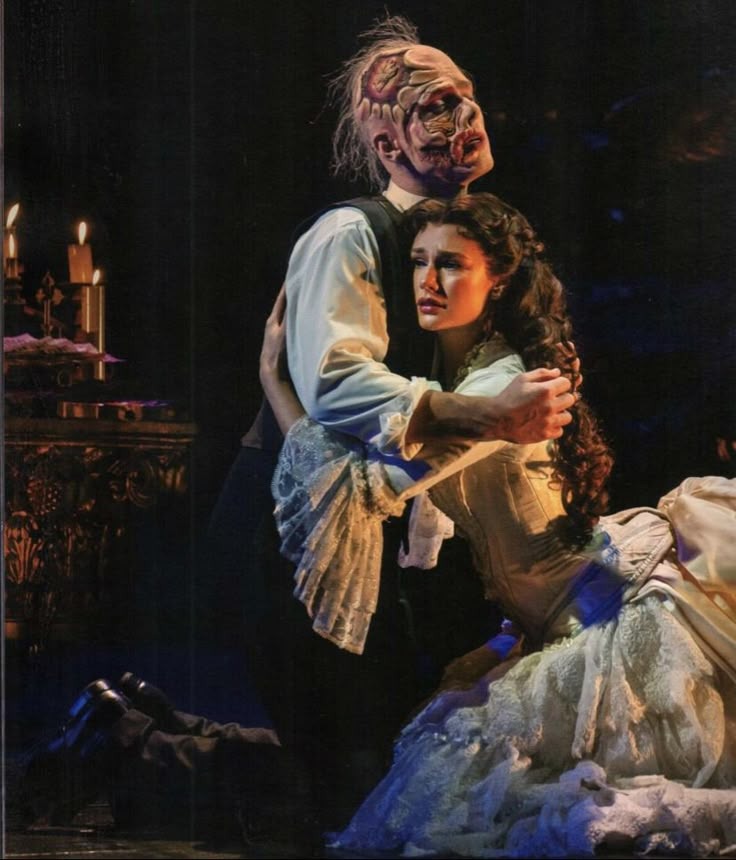
Christine Daaé is the Real Hero of The Phantom of the Opera
Written by Sinta MK
In the face of peril, Christine’s innocence and naivety easily form the “damsel in distress” misconception. The soprano singer has become the obsession of a lurking, mysterious figure at the Paris Opera House. She is taken hostage in his secret abode, being forced to accept matrimony. Christine’s complicated feelings, added with her inability to escape from him mentally, fuel the notion that she needs to be rescued. Even Raoul, her childhood love interest, thinks that he will be the perfect role for that. Along with the Persian, the only person who knows the ins and outs of the obscure man, helps him execute it. They failed. Not only did their enemy outsmart them, but Christine also ultimately saved herself. No guns or strategy involved, just a pure act of compassion that withstands any violence. But, how does she do that, when the one she faces is a dangerous, ingenious man with eyes everywhere — known as the opera ghost?
“In which the author of this singular work informs the reader how he acquired the certainty that the opera ghost really existed.” The Phantom of the Opera makes the most compelling opening lines for a mystery novel. The author, Gaston Leroux — positioning himself as the historian — convinced us that the mischief was real. The infamous chandelier scene was definitely based on a real event. What about the O.G., the opera ghost?
Christine Daae is among the people who dismiss its existence in the book. She doesn’t believe it at all. Instead, she occupies herself with improving her singing. Her skepticism shows that she isn’t superstitious. Yet, Christine receives her training from another “ethereal” figure. Before passing away, her father promised to send her the Angel of Music. To her disappointment, the being who is said to bestow greatness upon one’s musicality never comes. When one day a shapeless voice calls to her, she thinks it is the angel her father sends from heaven. Under his guidance, her voice drastically improved in 3 months. She is never aware that it is the same person as the O.G. Soon enough, Christine learns that his name is Erik. He is not just an ordinary man.
Christine is fascinated by Erik’s voice, which she describes as otherworldly. It is nothing she has ever heard before. At that time, Erik was still a masked figure. Apart from his majestic voice that seems to rhyme with hers, he has secrets even she can’t know yet. At one point, Erik’s obscurity raises her anxiety. While their relationship isn’t one-sided, she doesn’t feel safe around him.
The modern adaptations of The Phantom of the Opera minimize the harm Erik has committed. It also turns Christine and Erik’s relationship into a mere “tragic love story”. Romanticization of their abusive relationship in these adaptations doesn’t align with the spirit of the book. Sadly, this classic story has long been assimilated into a popular “triangle love” trope. Not only does the display of erotic intimacy undermine the toxicity, but it also reduces Erik’s character — one of the most intelligent antagonists in Gothic stories — to simply just a “lustful man in a mask”.
Christine’s feelings are too nuanced to be reduced to “love”. “Poor, unhappy Erik!” becomes her most frequent sentence, which conveys an underlying care and pity. Other times, she desperately escapes from Erik’s “omnipotence” gaze and dreads it. Once Christine realizes being beguiled by Erik’s schemes, she doesn’t run away. She patiently looks for ways, even it means returning to his cave alone. She endures the mistreatment bravely, offering her profound empathy and kindness. It was affection instilled with fear.
Regardless of the obsession, Erik hardly reveals anything about himself. He keeps himself hidden beneath the mask. It isn’t until Christine forcefully snatches Erik’s mask away that she discovers his biggest secret. Under that disguise, he is an ugly, deformed man — someone in his 40s or early 50s. A living corpse, with an extremely thin body that smells like death. He relies upon his mask to cover his impediments. Even she couldn’t look at him with disgust at first. But knowing his real face comes with a cost. She now has to stay with him for the rest of her life, or the Paris Opera house will be in danger.
Erik’s Personality
Christine describes him as “there is nothing in the world that he doesn’t know.” Before building the Paris Opera House, he is a magician, engineer, and constructor, who once served the little Mazenderan sultana. His obsession with Christine is rooted in his longing for a meaningful human connection. He was shunned by his own mother and society for his impediment, which perhaps distorted his moral compass. As a music prodigy, he has been composing a 20-year-old music titled Don Juan Triumphant, which nobody else but Christine had heard about. He states how music-making has consumed him, including his facial deformation.
Despite his sympathetic backstory, he is still a diabolical maniac. But after a number of crimes and horrors later, he finally desires a normal life.
Post a comment