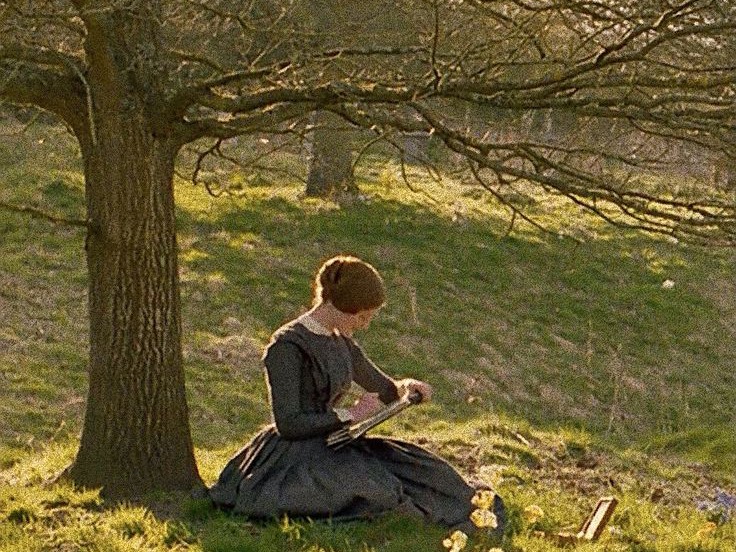
Becoming Jane Eyre or Jane Rochester: The Beauty of Self-Respect in Charlotte Brontë's Novel
Written by Sinta MK
“I am no bird; and no net ensnares me; I am a free human being with an independent will.” -Jane Eyre
Something is deeply alluring in Jane’s relentless integrity. It is her declaration of love, mingled with her unshakable principles, that stands out among other literary heroines. If Charlotte Brontë allowed her protagonist to pursue a sole obsession over love, we might have never acknowledged this classical work by the same title. Had her romance worked ideally from the beginning, there would be no Jane Eyre — only Jane Rochester. And it doesn’t align with Jane’s perseverance, who fights for her faith.
A sincere love was scarce for young Jane to learn from. As she falls in love with the love of her life, Edward Rochester, she discovers that her boundaries are constantly challenged. Her master is notorious for being hard to read. People would never know whether he’s serious or jesting. When he is with Jane, he exhibits a rigid nature and an emotional distance. His instruction reads as absolute; before him, Jane finds herself obedient. One day, she realizes that Rochester’s love comes with chains. Regardless of how obstinate he presents his name to her, Jane has made up her mind to leave.
Rochester: “Jane, you understand what I want of you? Just this promise — ‘I will be yours, Mr. Rochester.’’
Jane: “Mr. Rochester, I will not be yours.”
When I first picked up the book as a child, I had little idea that its tale would resonate with me 12 years later. Despite being drawn to it, my younger self struggled to comprehend the early Modern English text written on it. Interestingly, I only started reading years later, as I found myself at the intersection of an adulthood crisis. I immediately admired Jane’s self-respect. Her words, “I am no bird; and no net ensnares me; I am a free human being with an independent will,” are her resistance against anyone who tries to snatch her autonomy away. She doesn’t let someone hold her soul captive. Her refusal to live inside a birdcage still echoes today, reaching a dreamer like me. Her struggle reflects my journey within an imbalanced love, where self-government is sacrificed. This parallel renders Jane’s declaration even more meaningful to me.
The voices of women are as valuable as their souls, and this is what Jane has fought for. Mute them, and their spirits will slowly die. Jane isn’t afraid of expressing herself, even under pressure. She holds firmly to what she believes is right, and has proved to sacrifice her present happiness, Rochester, for her spirit to continue to bloom. Her concern is rooted in the limited roles women served in society; in the era of Jane Eyre, social expectations dictated that the best contribution women could make was to become wives. But Jane argues that, noting how every woman has their own devotion in life. Refusing to be ‘caged’, she longs for freedom to determine her own life. Ultimately, she encourages women to surpass their own limitations.
Jane’s determination wasn’t there from the start. Her resilience was built during her childhood, in which her harsh upbringing raised her sense of self-appreciation. Her aunt didn’t treat her the way a caring mother would. Her cousins never showered her with affection. When she was at Lowood, she was astonished by the school’s rigid system. She questioned her friend’s submissiveness under a harsh authority. Their conversations about morality were moving, where little Jane’s naivety meets Helen Burns’ maturity in viewing life.
Jane: ‘… But that teacher, Miss Scatcherd, is so cruel to you?’
Helen: ‘Cruel? Not at all! She is severe: she dislikes my faults.’
Jane: ‘And if I were in your place I should dislike her; I should resist her. If she struck me with that rod, I should get it from her hand; I should break it under her nose.’
Helen: ‘Probably you would do nothing of the sort: but if you did, Mr. Brocklehurst would expel you from the school; that would be a great grief to your relations.’
“Life appears to me too short to be spent in nursing animosity or registering wrongs…”
The moment when Jane walks away from Thornfield really touches me. Her master fails to love her fully, reciprocating Jane’s honesty with lies and secrets. Moreover, he sees Jane’s determination as an obstacle instead of an admirable quality. Be as it may, both of them are equal companions, intellectually and spiritually. Grief-stricken, she departs without cutting off her love for Rochester. Interestingly, by the time Rochester’s moment of confession arrives, it can be argued that his repentance is sincere at last; deep down, he truly loved the young governess. He even trampled his ego to beg for her mercy, so she wouldn’t leave Thornfield. Nonetheless, the strong-willed woman refuses to remain in her safe zone. Even though he has offered his excuses — and Jane has forgiven him —she doesn’t accept the reconciliation immediately. There’s a price she has to pay for Rochester’s humility in the future, and she recompenses that by freeing herself, unrestrained by anyone’s shadow.
It isn’t until her return to Thornfield that Jane has transformed into a much more empowered woman. Her wound has healed through her act of devotion as a teacher. She has also inherited his uncle’s wealth, granting her financial independence. And when she finally reunites with Rochester, she doesn’t carry grudges against him. Jane welcomes him with affection, even volunteering to keep assisting his ex-master. She refuses to complicate her life with marital obligations.
Jane: “I will think what you like, sir: I am content to be only your nurse, if you think it better.”
Rochester: “But you cannot always be my nurse, Janet: you are young — you must marry one day.”
“I don’t care about being married.”
Becoming a modern-day Jane means being determined enough to believe in our worth. Jane Eyre will always be my favorite feminist figure, who inspires me to hold on to love while standing my ground. It is not a grand stage or applause from society that she stands up for. It’s her valuing her own existence; that her life must have a purpose. She celebrates her independence and will continue voicing her opinions, not letting anyone silence her, even when living in a cage sounds easier. Her commitment to love is a part of her integrity. Not to aim for validation, but because it is her character. Jane Eyre is a bird that manages to flap her wings. From her story, she teaches me how to fly, even if scared and unsure. []
0 Comments Add a Comment?